Digest · All digests › Jeff Yan video archive

Jeff Yan video archive

Every public Jeff Yan (Hyperliquid co-founder) YouTube interview, fireside chat, and keynote we could find, processed video-by-video with multimodal AI and structured extraction — verbatim quotes with clickable timestamps, on-screen visual elements, novel insights not in the standard Hyperliquid marketing, and host context. Click any timestamp to jump straight to that moment on YouTube.

14
Videos
10.8h
Total runtime
84
Verbatim quotes
56
Novel insights

2023

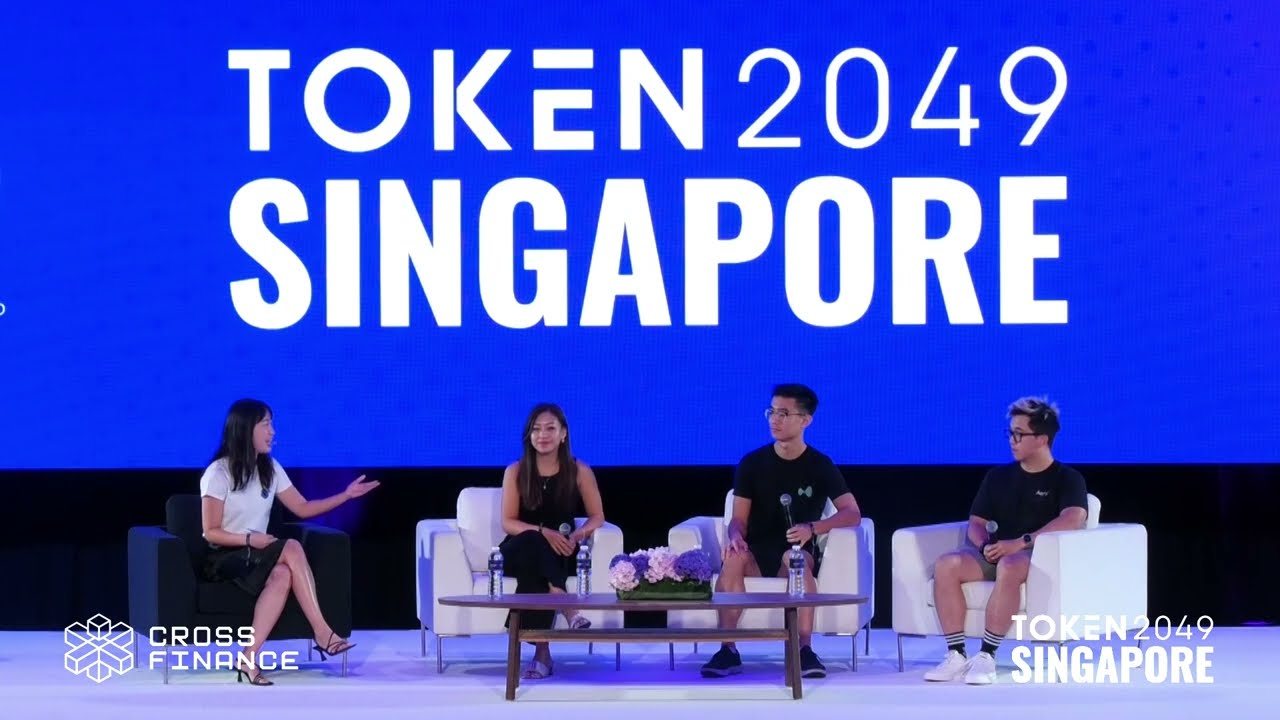
DEXplosion: Unleashing the Power of Decentralized Exchanges

DEXplosion: Unleashing the Power of Decentralized Exchanges

TOKEN2049 · 30m 33s · 2023 · TOKEN2049 Singapore 2023

Jeff Yan explains how building a custom, non-general-purpose L1 enabled Hyperliquid to put a full order book on-chain and eliminate MEV.

Custom L1 Architecture On-chain Order Books UX in DeFi MEV Mitigation Community Liquidity (HLP) Appchains vs General Purpose

In this Token2049 Singapore panel, Jeff Yan discusses Hyperliquid's strategic decision to abandon general-purpose rollups like Arbitrum in favor of a custom-built Layer 1 blockchain. He explains how this architecture allows for a fully on-chain order book with 20,000 TPS, eliminating the need for centralized sequencers or off-chain matching engines. Yan also highlights the success of the HLP (Hyperliquidity Provider) vault, which democratizes market making by allowing users to provide protocol liquidity, reinforcing Hyperliquid's ethos as the 'people's DEX.'

Key quotes (8)
“We like to think of it as sort of uh the brand as like the people's DEX, so we try to bring the ethos of crypto to uh decentralized perps trading.” [01:16]
“Instead of DMMs and uh other market makers with special privileges, we let uh users come in and provide protocol liquidity um bootstrapping it.” [01:34]
“If you wanted to place and cancel an order and you needed to like sign something each time and like 10% of the time it like bugs out, like that's just like not acceptable behavior.” [06:27]
“We built an L1 that is um custom built for Hyperliquid, the Hyperliquid L1. So it doesn't, it's not general purpose, it doesn't support smart contracts. It really just runs this state machine that is the DEX.” [12:18]
“Because it's so custom built and optimized, it has the throughput uh you know 20,000 transactions per second, can easily be pushed by another factor of up to 10 I think if push comes to shove.” [12:31]
Novel insights (4)
  • Hyperliquid initially attempted to build on Arbitrum but pivoted to a custom L1 during the testnet phase because general-purpose rollups couldn't support their specific performance needs.
  • The custom Hyperliquid L1 intentionally does not support general smart contracts; it functions purely as a state machine dedicated to running the DEX, which allows it to reach 20,000 TPS.
  • By building a custom L1, Hyperliquid can bake exchange-specific functions directly into the consensus layer, such as having validators handle liquidations automatically rather than relying on user-triggered transactions.
  • Hyperliquid's HLP vault generated nearly $1 million in PnL within its first four months by allowing regular users to bootstrap protocol liquidity instead of relying on privileged market makers.
Visual elements (4)
  • The video consists of a standard multi-person panel discussion on a stage at Token2049 Singapore.
  • A large blue backdrop displays 'TOKEN2049 SINGAPORE' and the sponsor logo 'CROSS FINANCE'.
  • An introductory slide at 0:05 shows the panel title 'DEXplosion: Unleashing the Power of Decentralized Exchanges' along with the headshots, names, and affiliations of the moderator and three panelists.
  • No charts, slides, or on-screen graphics are presented during the actual discussion.
Token2049 Singapore panel titled 'DEXplosion: Unleashing the Power of Decentralized Exchanges', moderated by Suyang Yang (Circuit).

2024

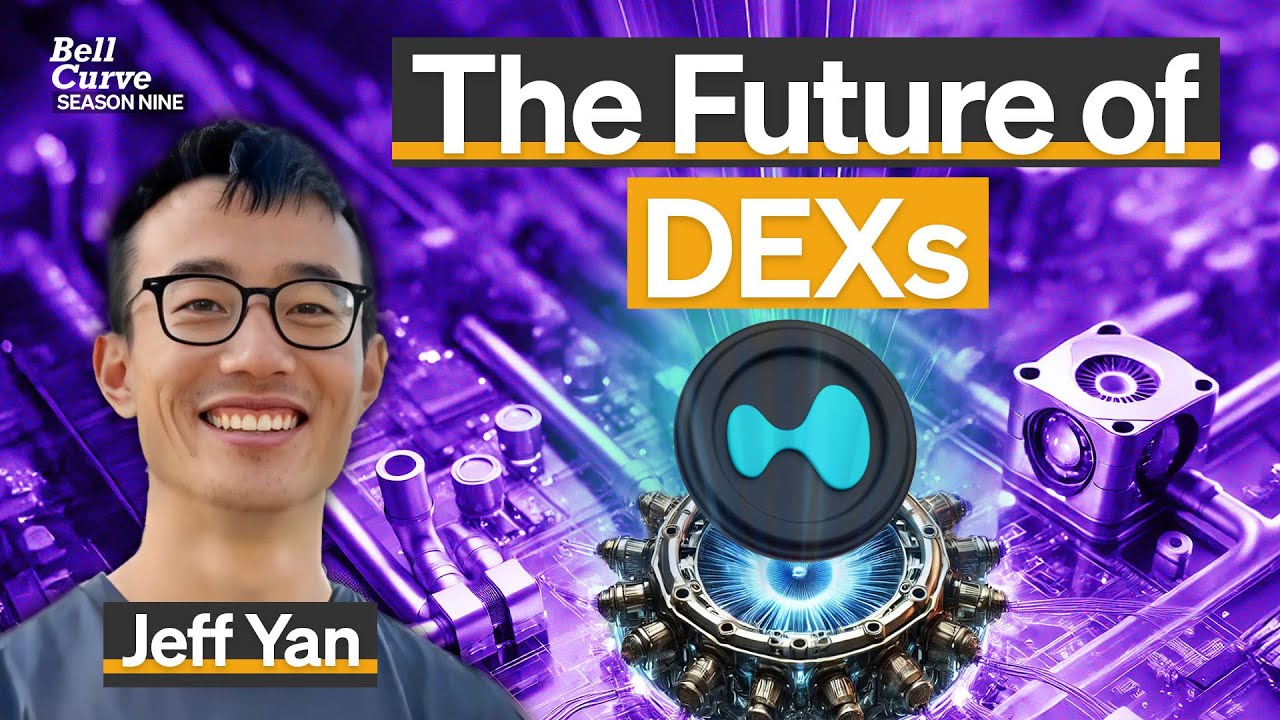
Hyperliquid's Bold Vision for DeFi | Jeff Yan | S9 E3

Hyperliquid's Bold Vision for DeFi | Jeff Yan | S9 E3

Bell Curve · 1h 28m · 2024

Jeff Yan details how Hyperliquid's custom L1 and HyperEVM solve DeFi's latency and MEV challenges through vertical integration.

Hyperliquid L1 HyperEVM MEV mitigation Vertical integration App-chains vs General Purpose On-chain order books

In this Bell Curve episode, Jeff Yan discusses the evolution of Hyperliquid from a specialized perpetuals DEX to a generalized L1 with the introduction of HyperEVM. He challenges the prevailing narrative that MEV is an unavoidable fundamental law, framing it instead as an engineering problem solvable through high throughput and custom consensus. The conversation highlights Hyperliquid's vertically integrated approach, contrasting it with modular ecosystems by emphasizing end-to-end optimization to rival centralized exchange performance.

Key quotes (5)
“We realized that basically all the infrastructure in crypto is kind of not production ready for this specific use case of a high throughput, low latency global exchange.” [07:30]
“I think MEV is an engineering problem, and we can mostly solve this problem.” [24:10]
“If a protocol can be set up in a way that it's well architected so that people can come in and actually express what they want to express... that's very powerful.” [41:15]
“The EVM is great for a lot of things, but if you want to build a highly performant order book, you really need to build it natively into the L1.” [52:20]
“We want to build a trusted financial layer for all of finance and kind of be built on top of.” [80:15]
Novel insights (4)
  • Jeff views MEV not as a fundamental law of physics in crypto, but as an engineering flaw that can be mitigated through custom consensus and high-throughput architecture.
  • Hyperliquid's decision to build a custom L1 was driven by the realization that existing infrastructure could not support a fully on-chain, low-latency order book without compromising decentralization.
  • The introduction of HyperEVM is designed to handle long-tail assets and composable DeFi applications, while the core order book remains natively integrated into the L1 for maximum performance.
  • Vertical integration (owning the stack from the L1 consensus to the frontend) is viewed as essential for competing with centralized exchanges on user experience.
Visual elements (4)
  • Three-way split screen video podcast format featuring Michael Ippolito, monet_supply, and Jeff Yan.
  • Ad insert for Permissionless IV conference showing speaker headshots and event dates.
  • Ad insert for Marinade Finance displaying their website interface, staking APY, and TVL.
  • Ad insert for Citrea featuring a 3D block diagram explaining Bitcoin ZK rollups, settlement, and execution layers.
Michael Ippolito and monet_supply on the Bell Curve podcast; remote video interview.
Jeff Yan - High Frequency Crypto Market Making & the Hyperliquid Exchange (S6E2)

Jeff Yan - High Frequency Crypto Market Making & the Hyperliquid Exchange (S6E2)

Flirting with Models · 1h 12m · 2024

Building a performant decentralized exchange requires a custom Layer-1 blockchain to overcome the latency limitations of existing crypto infrastructure.

High-Frequency Trading Market Making Toxic Flow Layer-1 Blockchains Decentralized Exchanges Infrastructure vs Modeling

Jeff Yan details his transition from traditional high-frequency trading to crypto, emphasizing that successful crypto HFT relies more on robust infrastructure than complex mathematical models. He explains the nuances of 'making versus taking' liquidity and how toxic flow impacts market makers. Finally, he outlines why Hyperliquid was built as a custom Layer-1 blockchain from scratch, arguing that existing general-purpose chains and off-chain order books cannot provide the latency and decentralization required for a truly performant on-chain perpetuals exchange.

Key quotes (6)
“The first big difference is that making is more infrastructure heavy and taking is more stats math model heavy.” [06:33]
“If you don't think about this stuff correctly, if you really just ignore all the outliers, then your model is going to be screwed over when the sort of black swan tail events do happen.” [10:00]
“I'd say it's impossible to spend too much time looking at data. You're always going to learn something new.” [10:44]
“In some sense automated trading is the dumbest trading because it's some simple state machine that has no human discretion.” [30:33]
“We basically decided this was not acceptable. This will not actually let us scale to the vision we actually want... we need to build our own blockchain.” [54:00]
Novel insights (4)
  • In crypto HFT, infrastructure (handling latency, parsing messy exchange APIs, managing connection drops) is a significantly larger source of alpha than sophisticated statistical modeling, especially for market making.
  • Many decentralized exchanges rely on off-chain order books or centralized matching engines, which Yan argues compromises the core ethos of DeFi and introduces counterparty risk.
  • Hyperliquid abandoned existing consensus frameworks because they couldn't support the sub-second latency required for a competitive order book, leading them to build a custom L1 from scratch.
  • Yan views 'spoofing' in crypto not necessarily as malicious manipulation, but often as a rational, albeit aggressive, strategy to test market depth and trigger poorly tuned algorithmic competitors.
Visual elements (1)
  • The video consists entirely of a static podcast cover art image featuring a cartoon illustration of Jeff Yan in armor. There are no charts, slides, or b-roll; it is an audio-only interview format.
Corey Hoffstein on Flirting with Models; audio-only long-form podcast interview.
The Bull Case For Hyperliquid w/ Jeff Yan

The Bull Case For Hyperliquid w/ Jeff Yan

Steady Lads Podcast · 57m 41s · 2024

Jeff Yan envisions Hyperliquid not just as a DEX, but as a unified, highly performant L1 capable of housing global finance on-chain.

Hyperliquid L1 HyperEVM HLP Vault JELLY Token Controversy DeFi Decentralization Stablecoins

In this episode of Steady Lads, Jeff Yan discusses Hyperliquid's evolution from a simple perpetuals DEX to a comprehensive L1 ecosystem. He candidly addresses the recent 'JELLY' token controversy, explaining the team's commitment to neutrality and permissionless deployment over appeasing short-term speculation. Furthermore, Yan outlines the strategic vision for HyperEVM, emphasizing its role in enabling developers to build novel DeFi applications that leverage Hyperliquid's deep native liquidity and high-performance consensus without competing for block space with generic smart contracts.

Key quotes (7)
“It kind of feels like you can no longer pick what to do on a day-to-day basis. A lot of things are just kind of like... the world tells you, hey, you need to do this, do that.” [08:02]
“The whole point of a startup, I guess, is... you just do everything you can to get product-market fit, and then nobody really says what to do after because so few startups get there.” [08:51]
“We're trying to build something much bigger and we're trying to build something that no one else is really even trying to build currently, which is interesting.” [07:24]
“The purpose of HyperEVM is largely to make Hypercore programmable.” [23:33]
“You can't build something that scales to provide the world's liquidity for price discovery if it's just some smart contract competing with the gas of every other smart contract.” [26:50]
Novel insights (4)
  • Hyperliquid's HLP (Hyperliquidity Provider) vault was originally created because FTX collapsed and the team wanted to provide a decentralized, transparent alternative to Alameda's market-making, but its role has decreased as external market makers have stepped in.
  • Jeff views HyperEVM not as a standalone general-purpose L2 competitor, but specifically as a programmable layer for 'Hypercore,' allowing developers to tap into native L1 liquidity without competing for gas with unrelated smart contracts.
  • Regarding the JELLY token controversy, Jeff emphasized that maintaining absolute neutrality and permissionless deployment at the protocol level is far more important for long-term trust than intervening to protect speculators from a meme coin dump.
  • Jeff believes that true DeFi requires applications to operate on a ledger with native, enshrined financial primitives, rather than just deploying standard smart contracts on a generic EVM where they suffer from fragmented liquidity and high latency.
Visual elements (4)
  • CoinMarketCap cryptocurrency prices list showing market downturns.
  • A scatter plot chart by Flexport showing 'Predicted Tariff vs Announced Tariff' regarding Trump's trade policies.
  • A slide titled 'The Hyperliquid Stack' detailing the architecture, including HyperCore, HyperEVM, native stablecoins, and the HyperBFT consensus mechanism.
  • Various meme images and tweets overlaid on the screen, including a Toy Story meme mocking 'points and referral codes' and tweets from Zhu Su and Cobie.
Jordi, Justin Bram, and Taiki Maeda on the 'Steady Lads' podcast (Episode 89); a casual, multi-host video podcast format.
Hyperliquid's Unique Approach to a Better Perp DEX

Hyperliquid's Unique Approach to a Better Perp DEX

0xResearch · 52m 37s · 2024

Hyperliquid's success stems from building a custom, performant L1 from scratch to solve specific trading bottlenecks rather than relying on generalized infrastructure.

Hyperliquid L1 Custom Consensus HyperEVM Vaults Primitive Cross-chain Bridging DEX Performance

Jeff Yan details the technical and philosophical decisions behind building Hyperliquid as a custom L1 rather than an app-chain on existing frameworks. He explains that achieving centralized exchange-level performance required writing a bespoke consensus mechanism based on Tendermint and a custom bridge. Yan also discusses the upcoming HyperEVM, which aims to bring general-purpose composability to their highly optimized trading environment without sacrificing throughput. Finally, he emphasizes a pragmatic approach to product development, prioritizing user experience and actual utility over crypto-native dogmas.

Key quotes (7)
“There's just no way to run proof of stake without a native token. And that is like, in my view, that is sort of like the only thing you really need an L1 token for.” [00:13]
“On the surface building an exchange or a DEX is a very simple problem... but the devil is in the details. And I think it really takes a team with heavy background in quantitative trading.” [04:24]
“The vault primitive is like if I want to sign on behalf of an address... you can sign on behalf of it, but not have permission to move the funds.” [09:00]
“The end product is like people can see the bridge and at least it's open source and we got it audited twice... but it's just a custom bridge.” [11:18]
“The ultimate plan actually with the Hyperliquid EVM coming out, a big reason is to be able to support a more diverse and more sort of like institutional set of bridges.” [13:00]
Novel insights (5)
  • Hyperliquid's vault system is actually a low-level L1 signing primitive rather than just a smart contract product. It allows users to delegate trading authority to an address without granting withdrawal permissions.
  • The team heavily modified Tendermint consensus to achieve 20,000 transactions per second. They found that execution, not consensus, is the primary bottleneck for high-throughput chains.
  • Hyperliquid built a custom bridge secured by a quorum of L1 validators rather than using existing solutions like IBC, prioritizing UX and specific asset support over standard interoperability.
  • The upcoming HyperEVM is not a pivot to a general-purpose chain, but a strategic move to allow institutional bridges and complementary DeFi protocols to compose atomically with their core order book.
  • The core development team currently takes zero fees from the protocol. All generated fees are routed to the insurance fund and the HLP (Hyperliquidity Provider) vault.
Visual elements (4)
  • Talking-head interview format with a three-way split screen featuring the host, co-host, and guest over a pink background.
  • Lower third graphics displaying the names 'boccaccio', 'Carolina', and 'Jeff'.
  • Sponsor overlay segments for Wormhole and Pear Protocol featuring a solo presenter.
  • No charts, slides, or technical diagrams were shown during the interview.
Hosted by boccaccio and Carolina on the 0xResearch podcast by Blockworks.
EP-38 Exclusive interview with Hyperliquid founder Jeff: How 11 people built Binance onchain?

EP-38 Exclusive interview with Hyperliquid founder Jeff: How 11 people built Binance onchain?

WuBlockchain Podcast · 36m 16s · 2024

Hyperliquid's success proves that a self-funded, community-first approach can outcompete traditional VC-backed models in building decentralized financial systems.

Self-funding Venture Capital Decentralized Finance Team Culture Centralized Exchanges FTX Collapse

In this interview, Jeff Yan details his journey from traditional quantitative trading at HRT to founding Hyperliquid in the wake of the FTX collapse. He explains the deliberate, contrarian choice to self-fund the project and reject venture capital, ensuring the protocol remains community-driven rather than extractive. Yan also discusses the lean 11-person team's engineering-first culture, their refusal to pay for centralized exchange listings, and his vision for a decentralized financial system built on free-market principles.

Key quotes (7)
“It was around then that FTX collapsed and we really saw the impact there and basically felt people were at that point going to understand the value of self custody.” [02:30]
“I think trading teaches you that money is really just a number and I'm not a super... I'm not very materialistic.” [05:36]
“Real progress is your users actually getting value from what you're building and users being able to benefit in the upside, not a bunch of investors who just like threw some money in at an early time.” [07:14]
“Our framework has always been focused on building and build what users want and don't care about what other people maybe like... just kind of stay focused, laser focused on what we're doing.” [08:13]
“We're 11 people... and it's about half half engineering and non-engineering.” [13:20]
Novel insights (5)
  • Hyperliquid operates with an exceptionally lean team of just 11 people (split evenly between engineering and non-engineering), deliberately avoiding the bloated, multi-department structures of centralized exchanges.
  • Yan views traditional VC funding rounds as 'fake progress,' arguing that true progress is measured by user value and community upside rather than artificial hype generated by successive funding announcements.
  • The team explicitly rejected paying for centralized exchange (CEX) listings or engaging in private deals with market makers, relying instead on organic adoption and the quality of their technology.
  • Yan avoids rigid long-term milestone planning (e.g., quarterly roadmaps), preferring a highly responsive, adaptable approach to engineering that prioritizes immediate technical challenges like HIP-3 implementation and system performance under load.
  • He believes the crypto industry has suffered from extractive, scam-style tokenomics, but remains optimistic that building robust, decentralized financial rails from the ground up is the only sustainable way to upgrade outdated traditional finance systems.
Visual elements (2)
  • Talking-head interview only. The video features a split-screen or alternating view of the host, Colin Wu, and the guest, Jeff Yan, on a remote video call.
  • An introductory title card displays 'WU BLOCKCHAIN', 'Hyperliquid: Self-Funding Philosophy and Future Vision', 'EP-38', alongside photos of Colin Wu and Jeff Yan.
Colin Wu (Founder of WuBlockchain) interviewing Jeff Yan via a remote video call for the WuBlockchain podcast/video series (EP-38).

2025

Hyperliquid Founder: Why Crypto Must Fix Finance Before AI Takes Over - Jeff Yan | E159

Hyperliquid Founder: Why Crypto Must Fix Finance Before AI Takes Over - Jeff Yan | E159

When Shift Happens · 1h 29m · 2025

Hyperliquid aims to be the 'internet for money,' building a neutral, permissionless, and unfragmented on-chain financial system.

Protocol Neutrality HyperEVM On-chain Finance Tokenomics Crypto Culture Decentralized Systems

In this conversation, Jeff Yan outlines the philosophical foundation of Hyperliquid, contrasting it with typical crypto projects that chase short-term hype. He emphasizes the importance of building a neutral, permissionless financial system—'housing all of finance'—rather than operating like a centralized corporation. The discussion delves into the strategic decisions behind the HyperEVM, the deliberate avoidance of discretionary token buybacks to maintain protocol integrity, and the cultural mindset required to build a globally scalable, on-chain financial infrastructure.

Key quotes (7)
“The main problem is that Hyperliquid does not have a discretionary buyback program. In the same way that Ethereum burns its priority fees, in that same way Hyperliquid burns its protocol fees.” [00:06]
“I hope Hyperliquid becomes the internet for money.” [00:44]
“I think finance is finance and crypto has the potential to upgrade the rails on which people conduct their financial lives.” [00:53]
“The crypto part of housing all of finance is that the platform on which people do this should not be controlled by a central corporation.” [01:08]
“It's rare that the people who are early to something can all participate in the upside and gain meaningful ownership over a network. I think that is very special.” [03:03]
Novel insights (4)
  • Hyperliquid deliberately avoids discretionary token buybacks, opting instead for a programmatic fee-burn mechanism similar to Ethereum's EIP-1559, to maintain strict protocol neutrality and avoid acting like a centralized corporation.
  • The HyperEVM is designed not just as an execution environment, but as a strategic tool to allow domain experts (e.g., in lending or stablecoins) to build native primitives directly on the Hyperliquid L1, fostering a composable ecosystem.
  • Yan views the current state of DeFi as fragmented and aims for Hyperliquid to 'house all of finance' by providing a unified, performant layer where different financial applications can seamlessly interact without bridging risks.
  • The team consciously ignores short-term metrics and 'FUD,' focusing instead on long-term architectural goals and maintaining a high 'integrity bar' for the protocol's design and operation.
Visual elements (5)
  • The video is primarily a studio interview, but utilizes frequent on-screen text overlays to emphasize key phrases spoken by the participants.
  • An animation of a burning Ethereum coin is shown to illustrate the concept of fee burning.
  • A brief screen recording displays the Hyperliquid trading interface, showing an order book and charts.
  • Abstract animations are used to represent concepts like blockchain networks, composability (puzzle pieces), and decentralized financial systems.
Studio interview on the 'WHEN [SHIFT] HAPPENS' podcast.
Hyperliquid Founder: How to Win in Crypto (by Building for Users, Not VCs) | E95

Hyperliquid Founder: How to Win in Crypto (by Building for Users, Not VCs) | E95

When Shift Happens · 1h 8m · 2025

Crypto's ultimate purpose is to reinvent the financial system from first principles, moving away from extractive, rent-seeking models.

Hyperliquid origins Centralized vs Decentralized Exchanges Crypto VC funding models L1 architecture AWS of liquidity Quant trading

In this interview, Jeff Yan discusses the origins and philosophy behind Hyperliquid, a performant L1 blockchain designed specifically for decentralized finance. He critiques the standard crypto playbook of launching tokens with VC backing, arguing it creates misaligned incentives and long-term scars on the network. Instead, Yan emphasizes the importance of self-funding, suffering through hard technical challenges, and building a user-centric platform that can eventually serve as the 'AWS of liquidity' for all of finance.

Key quotes (7)
“All of a sudden people had a real reason to not trust centralization exchanges.” [00:00]
“Crypto is like beautiful how inefficient the markets are.” [00:32]
“It really is humanity's only hope at reinventing the financial system.” [00:42]
“Working on something super hard is like suffering day to day. But I think you need to suffer, otherwise you have this much larger existential dread.” [01:02]
“I just don't think raising money... I don't think it's a negative signal, I just don't think it matters that much.” [03:53]
Novel insights (4)
  • Yan views the standard VC-backed crypto model as a 'scar on the network itself' because early investors extract value without contributing to the product's core utility.
  • He views the FTX collapse not just as a tragedy, but as the necessary catalyst that finally gave the broader market a genuine reason to adopt DeFi.
  • Hyperliquid was entirely self-funded by the founders' previous quant trading profits, allowing them to bypass the traditional token-launch playbook and focus purely on product-market fit.
  • He critiques the current crypto landscape as being overly focused on short-term plays and meme tokens rather than building infrastructure that rivals traditional finance.
Visual elements (4)
  • Kinetic text overlays during the intro highlighting key phrases like 'NOT TRUST CENTRALIZATION' and 'WORLD was ready for DEFI'.
  • Animated graphics showing Hyperliquid's UI, trading volume statistics ($1.5B/day), and network nodes.
  • Sponsor logos appearing in the bottom right corner throughout the interview (e.g., Jupiter, Sui, SwissBorg, DVIN Labs, Coinsilium).
  • A studio setting with a green screen background, a black table, and plush toys (a dog and a penguin with glasses).
Hosted on the 'When [Shift] Happens' podcast. The setting is a studio with a green screen and a black table.
Jeff Yan Built a $10B Protocol in Lululemon Shorts | EP 55

Jeff Yan Built a $10B Protocol in Lululemon Shorts | EP 55

Risk On · 1h 7m · 2025

The video discusses a highly flattering, almost mythical profile article written about Hyperliquid co-founder Jeff Yan, highlighting his intense competitiveness.

Hyperliquid Jeff Yan Profile Crypto Trading Founder Psychology Market Infrastructure Competitive Mindset

The hosts of the RISK ON podcast review a detailed, seemingly future-dated profile article about Hyperliquid co-founder Jeff Yan. They react to the article's portrayal of Yan as a highly competitive, ascetic genius who wears the same Lululemon outfit daily and views trading as a brutal but pure game. The discussion highlights how Hyperliquid is positioning itself not just as a crypto company, but as a fundamental financial infrastructure player. The hosts marvel at the intense, almost mythical quality of the piece, noting how it elevates Yan's status in the industry.

Key quotes (6)
“People don't say we're internet companies these days. We use crypto, but that doesn't define us.” [06:03]
“There was this race I wasn't aware of, that other kids had been doing their whole lives, and I was behind.” [06:46]
“Losing is a pretty common experience. Most people are losers. There's usually only one winner.” [06:54]
“It felt like there was this void. I should be studying something.” [06:55]
“I consumed them like a TV show.” [06:56]
Novel insights (4)
  • Yan views the brutal, zero-sum nature of trading not as a negative, but as a mechanism that produces an extremely valuable public good: liquid, efficient markets.
  • He intentionally distances Hyperliquid from the 'crypto' label, comparing it to how modern tech companies no longer call themselves 'internet companies'.
  • Yan's extreme focus is reflected in his ascetic lifestyle, reportedly owning 15 pairs of the exact same Lululemon shorts and 10 identical shirts to minimize decision fatigue.
  • His competitive drive was sparked in 8th grade when he realized he was behind other kids in math competitions, leading him to obsessively study old competition papers.
Visual elements (4)
  • A three-way split screen showing the podcast hosts (Wood, Swizzle, satsdats) reacting to the content.
  • A screen share of an article titled 'Colossus: Beyond the Sky' by Dom Cooke, dated April 2026, featuring a profile of Jeffrey Yan.
  • The article includes high-quality, dramatic portrait photos of Jeff Yan with moody lighting.
  • The article text is scrolled through on screen, revealing details about Yan's background, his time at Harvard, and his philosophy on trading.
Wood, Swizzle, and satsdats on the RISK ON podcast (Episode 55); a casual, conversational stream reviewing crypto market news and a specific article about Hyperliquid.
Fireside Chat with Hyperliquid Founder Jeff Yan

Fireside Chat with Hyperliquid Founder Jeff Yan

TOKEN2049 · 32m 8s · 2025 · TOKEN2049 Singapore 2025

Jeff Yan argues that perpetual futures are the ultimate financial instrument and Hyperliquid aims to house all of finance on-chain.

DeFi UX Perpetual Futures Incentive Design Appchains Builder Codes Stablecoins

In this fireside chat at TOKEN2049, Jeff Yan explains how Hyperliquid's success stems from eliminating the friction between the blockchain and the application layer. He outlines a contrarian team structure where core protocol and application development blur, allowing independent teams to build features like spot trading. Yan also shares his vision for housing all of finance on-chain, arguing that perpetual futures are a superior, more efficient instrument than traditional dated futures or options for most retail and institutional speculation.

Key quotes (7)
“the chain finally and the application really kind of are not fighting each other” [00:26]
“If you follow the capital it tells one story and if you follow the what's really going on like the product it tells a different story.” [01:53]
“There is often a clear line between the core developers of a protocol and the application developers on top. I do think that line is very fuzzy for Hyperliquid.” [03:10]
“markets are just a small set of rules and then everything that follows is a corollary of those rules.” [04:33]
“Ultimately like why a market exists is to take user A and user B and kind of connect them in the most efficient way possible.” [05:13]
Novel insights (4)
  • Yan views the traditional separation between core protocol developers and application developers as a hindrance; Hyperliquid intentionally blurs this line, allowing independent teams to build core features like spot trading.
  • He argues that perpetual futures are not just a crypto-native casino product, but a mathematically superior instrument for price speculation that will eventually cannibalize traditional dated futures and options.
  • Hyperliquid's 'Builder Codes' are designed to decentralize protocol growth by allowing anyone to permissionlessly deploy and monetize new perpetual markets, effectively turning market creation into a free-market competition.
  • Yan believes that early DeFi UX was fundamentally broken because blockchains and applications were 'fighting each other,' requiring a full-stack rebuild from the L1 up to abstract away wallet friction and signing delays.
Visual elements (3)
  • Title card for TOKEN2049 Singapore sponsored by TEXIT coin.
  • Title card introducing the 'Fireside Chat with Hyperliquid Founder Jeff Yan' featuring headshots of Hart Lambur and Jeff Yan.
  • Talking-head interview format with Hart Lambur and Jeff Yan seated on stage in front of a large screen displaying 'TOKEN2049 SINGAPORE'.
Hart Lambur (Risk Labs Co-Founder) interviewing Jeff Yan at TOKEN2049 Singapore.
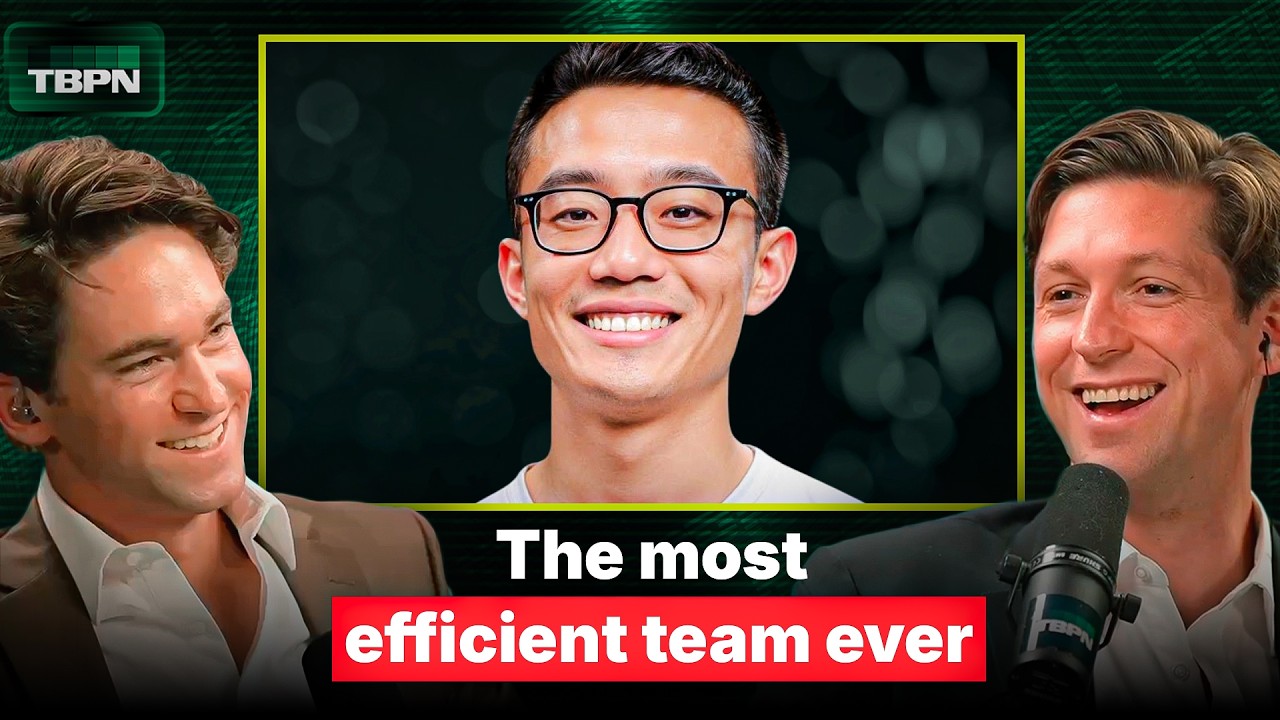
Building a $10B+ DeFi Protocol with Just 11 People | Jeff Yan Joins TBPN

Building a $10B+ DeFi Protocol with Just 11 People | Jeff Yan Joins TBPN

TBPN · 30m 50s · 2025

Jeff Yan explains how Hyperliquid's non-VC, credibly neutral approach aims to build the foundational, decentralized infrastructure for all of finance.

Decentralized Finance (DeFi) Hyperliquid Origins Venture Capital in Crypto Perpetual Futures Credible Neutrality Blockchain Architecture

In this interview, Jeff Yan details the philosophical and practical origins of Hyperliquid, emphasizing the FTX collapse as a visceral catalyst for building a truly decentralized, self-custodial exchange. He explains the deliberate choice to avoid venture capital to maintain credible neutrality and align with Satoshi's original ethos. Yan also discusses the technical and cultural challenges of scaling a high-performance blockchain with a lean, 11-person team, while outlining his vision for Hyperliquid to eventually house all of finance.

Key quotes (7)
“There will never be another Bitcoin then. Anything after Bitcoin needs to launch in a like very competitive market. There needs to be innovation and something needs to fund that.” [00:00]
“The sort of impetus for going all in and building Hyperliquid was when FTX collapsed. It felt like suddenly the previously very academic concerns in crypto around decentralization and self-custody... all of a sudden it was very viscerally important.” [01:18]
“Bitcoin would not be Bitcoin if he had raised a Series A. Even if best investors in the world, sickest cap table ever, still would not... Bitcoin would not be Bitcoin.” [04:11]
“When you're building something that needs to be credibly neutral in the long term and the history matters, I think we'd rather go slow and do it right.” [05:18]
“We just thought like okay like what's one really really big thing in crypto that we think could benefit from a fully permissionless platform and perps trading was the obvious one.” [07:31]
Novel insights (4)
  • Yan views venture capital as fundamentally incompatible with building a 'credibly neutral' protocol, arguing that even the best cap table would have ruined Bitcoin's genesis.
  • Hyperliquid operates with an extremely lean team of only 11 people, deliberately avoiding traditional marketing or advertising agencies.
  • Yan draws a direct parallel between Amazon's AWS and Hyperliquid; just as Amazon abstracted its internal infrastructure into AWS, Hyperliquid aims to abstract its high-performance L1 into a general-purpose financial ledger.
  • The team is shifting to an in-person only model for new recruits to maintain a high-density, high-competence engineering culture, actively avoiding a '9-to-5' mentality.
Visual elements (4)
  • Talking-head interview format with three participants in a split-screen layout.
  • A bottom ticker displays live crypto prices, stock prices, and Polymarket betting odds.
  • A title card reads 'HYPERLIQUID CEO JEFF YAN ON TBPN' with his title and Twitter handle.
  • The TBPN logo and 'Presented by ramp' are visible in the top corners.
TBPN (The Boys Podcast Network) hosted by two interviewers. It is a remote, split-screen video podcast.
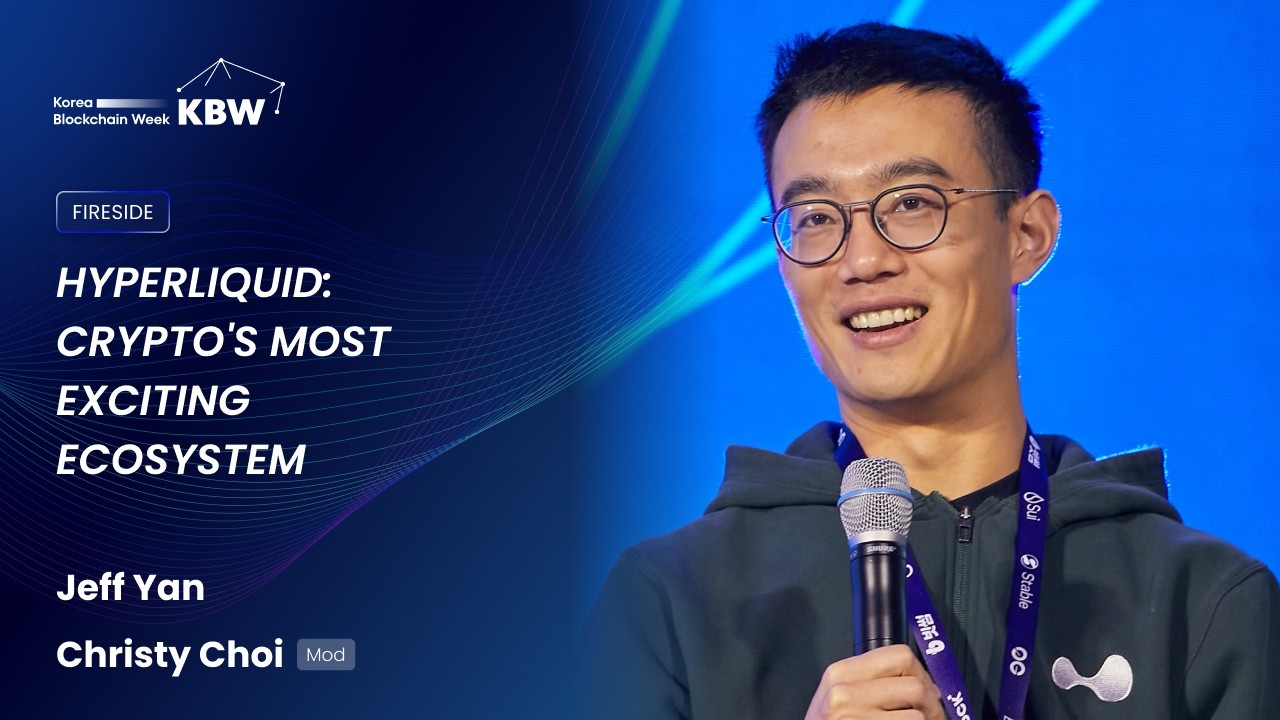
Reclaiming the Soul of DeFi: Jeff Yan on Hyperliquid's Grassroots Revolution at KBW2025

Reclaiming the Soul of DeFi: Jeff Yan on Hyperliquid's Grassroots Revolution at KBW2025

Korea Blockchain Week · 23m 22s · 2025 · KBW 2025

Hyperliquid aims to restore OG DeFi integrity by empowering a decentralized community of builders without corporate bureaucracy.

DeFi Philosophy Protocol Governance HyperEVM Community Building Decentralized Finance Infrastructure Spot Trading

This fireside chat at Korea Blockchain Week features Jeff Yan discussing the philosophical and technical foundations of Hyperliquid. Unlike typical crypto projects, Hyperliquid Labs operates as a lean, purely technical team, relying entirely on its community for marketing and growth. Yan emphasizes the importance of transparent governance, avoiding insider advantages, and building resilient financial primitives like on-chain order books that external developers can leverage via the HyperEVM.

Key quotes (6)
“Hyperliquid sort of represents what DeFi and crypto sought out to be.” [01:42]
“I think people in crypto are kind of tired of these insider-y, crypto in name but really just web2 companies under the hood kind of setups.” [05:12]
“We're a small tight-knit community, sort of a group of misfits not working at these big established protocols and companies, choosing to leave that behind and start from scratch.” [06:34]
“The core team actually is really just a technical team. Like we have no marketing department, we don't do sales, and the community kind of carries that.” [11:00]
“Anything that Labs doesn't need to do, I don't think it should. I think if something can be built by the community or by someone in the community, it should.” [11:26]
Novel insights (4)
  • Hyperliquid Labs intentionally operates without marketing or sales departments, relying entirely on organic community distribution to maintain its 'OG DeFi' ethos.
  • The decision to leave the USDH stablecoin ticker to a community vote wasn't '4D chess,' but a principled stance against reserving tickers, which Yan felt gave unfair advantages.
  • Yan views Hyperliquid's infrastructure not just as an exchange, but as a foundational layer where external teams should build adjacent services like spot bridging and custody to ensure protocol resilience.
  • The HyperEVM is designed to solve the 'cold start' liquidity problem for builders by allowing smart contracts to interact directly with native L1 primitives like the on-chain order book.
Visual elements (3)
  • The video is a standard talking-head panel discussion on a stage.
  • A large digital backdrop displays 'IMPACT', 'KBW', 'Sui', and 'Hyperliquid's Jeff Yan'.
  • No slides, charts, or on-screen graphics are presented during the conversation.
Christy Choi (Co-Founder of SKYGG) hosting a fireside chat with Jeff Yan at the Korea Blockchain Week (KBW) IMPACT conference.
Hyperliquid Founder Jeff Yan Believes Crypto's Biggest Ideas Don't Exist Yet

Hyperliquid Founder Jeff Yan Believes Crypto's Biggest Ideas Don't Exist Yet

Korea Blockchain Week · 0m 22s · 2025

Jeff Yan emphasizes a commitment to pioneering new concepts rather than settling for safe, derivative bets in crypto.

Innovation Product Strategy Pioneering Crypto Development Founder Philosophy

In this brief conference clip, Jeff Yan outlines his team's core philosophy of innovation and product development. He explicitly rejects the strategy of being a 'quick follow' to already successful projects, a common tactic in the crypto industry. Instead, he asserts that the most impactful developments in the space are still waiting to be imagined and built.

Key quotes (3)
“I think we've taken pride in always being the first to do things and we're not super interested in like safe bets...” [00:00]
“...safe bets which are following quick, quick follows onto things that are successful.” [00:07]
“We think the best things have yet to be imagined and have yet to be built.” [00:13]
Novel insights (3)
  • Yan explicitly rejects the 'fast follower' strategy common in crypto, framing his team's mandate around absolute novelty rather than iterative safety.
  • He views the current landscape of successful crypto products as incomplete, asserting that the most important primitives haven't even been conceptualized yet.
  • The team's core cultural driver is a sense of pride derived specifically from being first-to-market with new ideas, rather than just capturing market share.
Visual elements (3)
  • Talking-head shot of Jeff Yan speaking on a panel, wearing a green hoodie and a conference lanyard.
  • Dynamic on-screen text overlays emphasizing key phrases from his speech, such as 'The Best Is Yet to Be Imagined'.
  • Closing promotional graphic for KBW2026 (Korea Blockchain Week) with dates Sep 30 - Oct 1 at Walkerhill Hotels & Resorts and a stylized photo of Seoul.
Panel discussion at Korea Blockchain Week (KBW), based on the closing promotional graphic.
Jeff Yan, Founder of Hyperliquid, Live at KBW2025

Jeff Yan, Founder of Hyperliquid, Live at KBW2025

Korea Blockchain Week · 0m 19s · 2025

Jeff Yan asserts that Hyperliquid's most important attribute is representing the original vision of DeFi and crypto.

Hyperliquid DeFi Vision Crypto Ethos Decentralization

In this extremely brief conference clip, Jeff Yan discusses the core value proposition of Hyperliquid. Rather than pointing to a specific technical feature, he emphasizes its philosophical alignment with the space's origins. He states that Hyperliquid embodies what DeFi and crypto originally sought to achieve.

Key quotes (1)
“It's not one thing, but I'd say going down the list the most important thing in my mind is that Hyperliquid sort of represents what DeFi and crypto sought out to be.” [00:00]
Novel insights (3)
  • Hyperliquid's ultimate value is framed as a philosophical realization of crypto's original goals rather than a specific technical feature.
  • Yan implies a critique of the broader DeFi ecosystem, suggesting that many projects have failed to achieve what they originally sought out to be.
  • The prioritization of ethos over mechanics indicates a mission-driven approach to the protocol's development and positioning.
Visual elements (3)
  • Jeff Yan speaking on a conference stage with blue background lighting, wearing a green hoodie.
  • Dynamic on-screen text captions highlighting his spoken words, with a persistent title 'Hyperliquid: DeFi's True Promise?'.
  • An end-screen graphic promoting 'KBW2026 Tickets Available Now' with a black-and-white photo of Seoul and the Walkerhill Hotels & Resorts venue.
Korea Blockchain Week (KBW) conference stage.

Methodology

Each YouTube URL is processed directly by a multimodal AI model — it ingests the audio track and key visual frames without us downloading the videos. The prompt requests strictly-typed JSON with headline, summary, topical tags, verbatim quotes (with timestamps where they can be resolved), visual elements, and novel insights. Responses are reviewed for accuracy on a spot-check basis. Where the source video has captions or speaker IDs, the model uses them; otherwise it transcribes from audio. Median processing time per video: ~60 seconds end-to-end. Failed extractions (typically unterminated-string truncation at 16K-token output cap) are retried; one video shown below remained problematic and links directly to YouTube.